Sealing features
Raised sealing features are designed to conform against the inside surface of the casing during expansion.

1776 / TECHNOLOGY
A wedge advances into a deformable receiver. The interaction converts axial movement into outward expansion toward the casing.
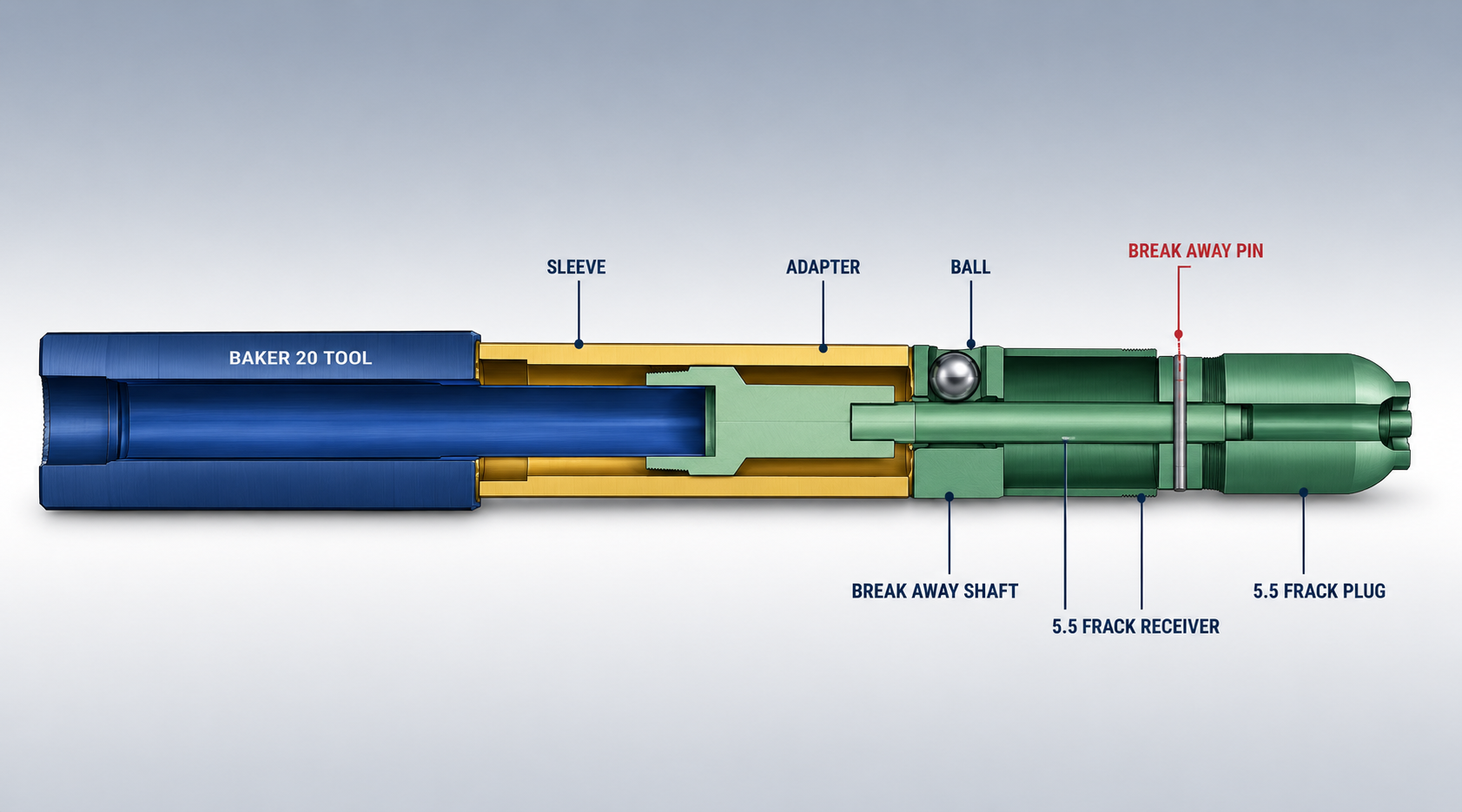
THE SEQUENCE
The aluminum receiver is designed to undergo plastic deformation: a permanent change in geometry that supports continued engagement after setting.
The plug, receiver, adapter, breakaway shaft and ball begin in their starting positions within the assembly.
The setting action draws the plug into the receiver.
The component interaction expands the receiver radially toward its set diameter and into engagement with the casing.
The illustrated arrangement allows the setting equipment to separate and the ball to move into its final position.
This explains the concept. Actual deployment requires an approved operating procedure.
INTEGRAL FEATURES
Radial expansion, casing engagement, mechanical anchoring and sealing are combined in the deformable receiver.
Raised sealing features are designed to conform against the inside surface of the casing during expansion.
Integral wickered or textured regions are designed to resist axial movement under differential pressure and other downhole loading.
The described arrangement activates these features through deformation of the receiver itself, rather than a conventional separate slip assembly.
ENGINEERING THE CONFIGURATION
Casing geometry, material selection, pressure and temperature guide the configuration. Review the design and its application requirements with the 1776 team.